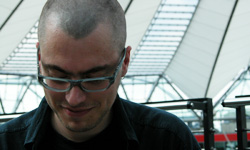
Florian Thalhofer
IF THEN
The world is too vast. Too vast and too complex to fit into my small head. So I use a trick which goes as follows: One by one I take small pieces of the world and try to understand them as best I can. I collect these small pieces of the world in showcases in my head. Each time I get a new piece of the world, I search through my collection until I find a similar piece. I file the new piece in the correct order in my collection, thereby expanding my knowledge and use what I have learnt from other pieces of the world to help me understand the new piece.
I think everyone does that.
But of course this doesn’t mean that I understand the world. At least I understand my collection. That is why it is important to always make new links, create new connecting threads between the pieces of the world.
IF
What would have happened if it hadn’t been freezing cold when I came back from Cairo? If my tank on the balcony hadn’t frozen over? If I had decided not to carry the heavy object into the bathroom, hadn’t been fascinated by the massive block of ice and hadn’t been consumed by the desire to save my automatic watering system. But perhaps all that has nothing to do with the fact that I am now lying in hospital, or rather standing, and unable to pee properly.
THEN
A slipped disc.
Decisions.
In hindsight life is always linear. In advance life sometimes seems unforeseeable.
Life is a story. Not an incessantly exciting story and not entirely a story with catharsis, a plot and commotion. But rather the kind of story you want to tell your grandchildren. A story that grandchildren will want to hear. That is how I imagine it at any rate. My slipped disc is merely an episode. Hopefully one with a happy end.
In 1997 I tried for the first time to write down stories for my grandchildren. Perhaps a little hasty since I don’t even have children. I did not have a clue about writing, but i had a computer, so i used this machine to write down and file the stories. It wasn’t a conscious decision, the thing was just there, sitting in front of me.
Memories.
In my thoughts I am walking down the street in front of my parents’ house. I see the tree still standing there, where my brother Christof’s dog always peed. The dog is dead now. I think of the neighbours who were always getting annoyed, and think of my neighbour in Berlin. He also has a dog and his neighbour always gets annoyed, too. I get so carried away that one story just leads into another. But if the stories, the episodes, or as Heinz Emigholz said, the smallest narrative units (SNUs), are concordant, like pearls or pieces of candy, then the spectator also has fun “progressing” through such a “story”.
The result, the CD-ROM [small world] has worked well. I am always happy to show it again, it’s so terribly simple. It’s about Bavaria and beer and your first love. It’s a beautiful mixture, you just don’t need a plot.
Then two years later, Willem Velthoven from Mediamatic Magazine from Amsterdam asked if I would be interested in publishing my [small world]. Of course I wanted to, but that left me with a problem. Because I had forgotten one episode. An important story, as my friend Mr Pollach from Amberg pointed out to me. So it meant that it had to unpick my entire [small world] and stitch it all back together. All because of one story! I never wanted to be in the same situation again. That was the beginning of the idea, that each episode, each SNU should be able to identify its own partners, other stories with which it belongs. Database Driven Narrative. This means that each part of the story (SNU) is assigned metadata, keywords, so that each SNU can find similar SNUs. If you want to add a SNU, the SNU is assigned keywords and hey presto it’s in the “story”. Just like a story that has been entirely forgotten and then suddenly it’s there again, as a part of the whole thing.
Thinking.
Thinking is placing the thoughts in your head in a meaningful order. I’m not very good at abstract thinking. I have to think in images and stories. Otherwise I lose track.
Non-linear Narrative.
The Bible is a fabulous book. We were told stories from the Bible in playschool and painted pictures in our books. As children this introduced us to a very complex conception of the world. If our RE teachers had later not read as much into it, perhaps the conception would also have been a very open one.
Democracy.
When you make a film, you have to assume full responsibility for reinforcing each scene on all others for eternity. A huge responsibility yet also a presumption. Since the world is not so simple. Of course you cannot portray all references in a non-linear interactive system. The world is too complicated for that. However you can achieve greater convergence. That is, one point.
Dictatorship.
However the freedom of the spectator only takes place within a framework provided by the author. If the author goes about it well, the spectator will be unaware of the boundaries. The spectator believes in his supposed freedom and is uncritical of the possibly manipulative impulses of the author. We learn from MacDonalds that a wide choice does not necessarily mean great freedom. A large choice, but all the same.
Attention.
In an interactive narrative the author can address the spectator directly. “How do you like the hairstyle of the central character?” You can ask this type of question even in a film. But you won’t know whether the spectator gets involved in the question. Is the spectator thinking about my question, or simply dosing in his comfy cinema armchair. If the spectator doesn’t choose to get involved in the interactive narrative, it goes no further. If the spectator wants to go further, he has to think. Thoughts demanded by the author. The author has the spectator’s mind exactly where he wants it. To the exact centimetre. This means that the author either has a very attentive spectator, or none at all.
[korsakow syndrome].
The [korsakow syndrome], an interactive, non-linear documentary “film” on the subject of alcohol, was created in 2000. Numerous interviews, tales, documentary material and an alcoholic musical self-experiment by Berlin artist Jim Avignon, the vodka concert. Use of a database ensured that the individual sequences were related to each other according to certain rules and meanings. In order to create the [korsakow syndrome] I wrote an authoring tool. A program which responded to my requirements for interactive narration.
Author.
At this point there is usually a question from the public that I will enjoy trying to answer: What is the role of the author in this type of project, if the spectator determines his own course of events?
The author defines the content, the author determines the possible relations. The spectator is located within a framework permitted by the author. This type of project is therefore always an author’s project. The author is the author, the spectator is the spectator, although the spectator may sometimes feel a bit like the author. Perhaps by viewing this type of creation the spectator develops the feeling that he is a serious part of the work. It is a trick that the author must pull off.
Garden.
The author is like an architect designing a garden. Taking the garden as the film, the spectator is being lead along a piece of string - the time - down a predefined path through the park. The mind of the spectator is set in a contraption and can only see what the author has planned for them to see. If the spectator wants to look at a flower for a moment longer or to study a sign more closely: The spectator is hanging on to the string and cannot organise his time. The spectator is lead further along or must linger in one spot which he may not necessarily like.
The more interactive the garden, the more freedom the spectator has. The next small step towards interactivity is the possibility that the spectator stops holding the string which is leading him through the garden. The spectator is immediately handed a large share of responsibility. He must plan out his own time. Decide whether he wants to think about something or not. Stop and Play. Stop to Think.
The spectator has the largest measure of freedom in this garden when he can spend time anywhere in the garden independent of physical laws and has all information at his disposal at all times. That is, however, apart from the sensation of the first experience of a rather boring imagination. Only gods cope with such a situation. People have a tendency to not want to not knowing what they want. People feel overburdened by the selection of possibilities. A world in which you can do whatever you want turns out to be rather boring. Complete freedom lies somewhere near ‘boring’ on the ‘cool to boring’ scale.
Zero Interaction.
Zero interaction is not necessarily bad. In fact it is often desired. Our confined spectators in the linear garden can have lots of fun. It’s just down to the garden. It must be formed accordingly. If our garden were a roller coaster or a water slide for example. In America people pay lots of money to be lead through water parks on machines.
Cool Computers.
Due to the technical conditions of the pre-computer era, many people were occupied with creating linear gardens. Numerous experiences were gathered, both on the architects’ as well as on the spectator’s sides.
The technical development of the past few years has been staggering. With this tiny device sitting in front of me on my hospital bed table I can do things that machines costing the same price as a house were not able to make happen a short while ago. We are becoming more and more familiar in dealing and thinking with these machines. Something which until a few years ago required the skills of a trained programmer, can now be built with a bit of hard work and patience. Filmmakers have computers right under their noses. Writers, scriptwriters, everyone uses the Internet, googeling and linking the world together. Using this medium for "telling" "stories" and making "films" will happen. It does already. But it will take a while until a blockbuster is created. Perhaps the breakthrough will not come with a big bang. Since man has been writing, he has written linear stories. For a good long while. Useful computers have only been around for a few years.
[korsakow system].
After I submitted my dissertatio-project, the [korsakow syndrome] to the University of the Arts, Berlin (UdK), Willem Velthoven, who was a professor at the UdK at the time, asked me if I wanted to teach in a new “interactive narration” class. (And of course I wanted to).
Velthoven has been involved for several years in the intuitive and argument-based working narrative database principle. The CD-ROM “Doors of Perception” in 1993 helped develop important basic principles. Considerably more extensive than my [small world], the “Doors of Perception” CD-ROM was hard-linked, there was no database in the background. It is a great pleasure to listen to Willem Velthoven talking about what an immense logistical task it was finding the meaningful links without losing sight of the whole.
For two years at the University of the Arts in Berlin I have been developing the tool I originally wrote to make the [korsakow syndrome], the [korsakow system]. The [korsakow system] is a program that enables authors to create narrative projects without programming knowledge. Students in the interactive narration class are working with the program. After two extremely intensive workshops with international filmmakers we were able to gather amazing knowledge. In total approximately 100 different works have so far been created using the [korsakow system].
[korsakow foundation].
The [korsakow foundation] was established in Amsterdam in February. The [korsakow foundation] will organise workshops in conjunction with film and media festivals in numerous European cities and provide support for work with (..support for work on) the [korsakow system].
Expedition.
I will be released from hospital tomorrow. My stay here has lasted two weeks. Although I have just been lying in bed for the most part, the time seemed like a journey. An expedition into the world of the ailing. And as on all my journeys, I have collected new exhibits for the museum in my mind. New images, new stories. I hope that some of the pieces will not simply be displayed in a showcase without further comment. Pieces that make it necessary to create new links, new threads. Since these kind of pieces are the most valuable. They make the picture of the world more complex. And more true.
(This is not the printed version of the text, this is the non-corrected version)
English translation published by Dox-Magazine, Issue #46, April 2003